Best Cutting Board Material: Wood vs. Plastic, Bamboo & More
Which cutting board is best for your knives, your food, and the way you actually cook? Here’s how wood, plastic, bamboo, rubber, composite, and glass really compare.
Affiliate Disclosure: This post may contain affiliate links. If you purchase through one of these links, Elevated Home Kitchen may earn a commission at no additional cost to you. I only recommend products that I believe offer real value for home cooks.
A good cutting board probably doesn't get the same attention as a good chef's knife, but it should.
You can spend $200 on a beautifully sharpened chef's knife and then undo some of that investment by chopping against a surface that's simply too hard. On the other hand, the softest, most knife-friendly board in the world isn't very useful if it's too cumbersome to clean or maintain.
So, what is the best cutting board material?
For most home cooks, my answer is wood... particularly a quality hardwood such as maple, for your primary prep board, paired with a separate dishwasher-safe plastic board for raw proteins.
But that doesn't make plastic, bamboo, rubber, or composite boards bad choices. They simply excel at different jobs.
Your Cutting Board Is Only Half the Equation
A good cutting surface can help protect your knife, but it can’t make up for the wrong knife—or one that’s already dull. If you’re building a better knife-and-board setup from the ground up, start with How to Choose the Right Chef’s Knife for Your Hand and Cooking Style. And if your current knife isn’t cutting quite like it used to, read Why a Dull Knife Can Be More Dangerous Than a Sharp One to learn why keeping a sharp edge matters for both efficiency and safety.
Once your knife is squared away, let’s make sure the surface underneath it is doing its part too.
Let's break them down.
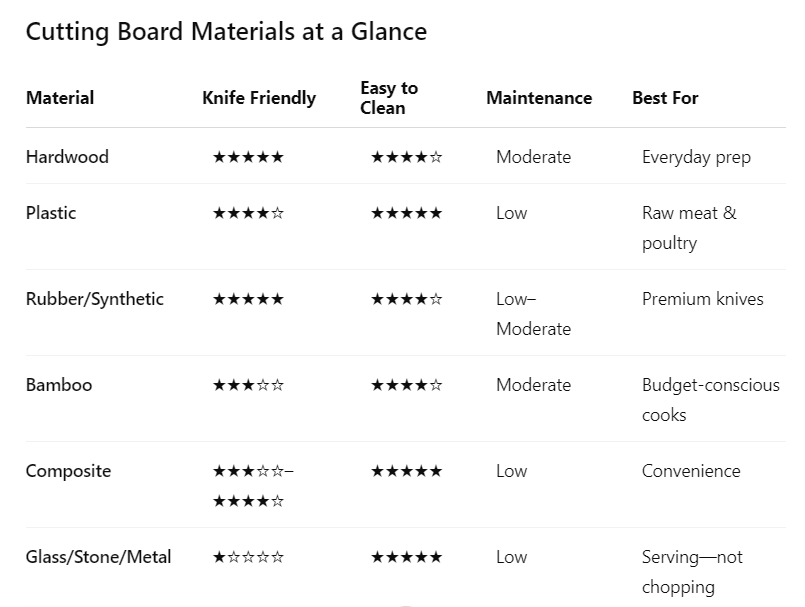
Comparison chart of cutting board materials (hardwood, plastic, rubber or synthetic, bamboo, composite, and glass, stone, or metal) rated for knife friendliness, ease of cleaning, maintenance, and best use.
My recommendation:
Buy a large hardwood board for most of your cooking and keep a separate dishwasher-safe plastic board around for raw chicken, meat, and seafood.
Why?? Well, using separate boards for raw meat, poultry, and seafood versus foods such as produce and bread reduces your chances of cross-contamination. The USDA and I align on this matter.
1. Hardwood Cutting Boards: Best Overall
If I could choose only one cutting board material for everyday cooking, I'd choose hardwood.
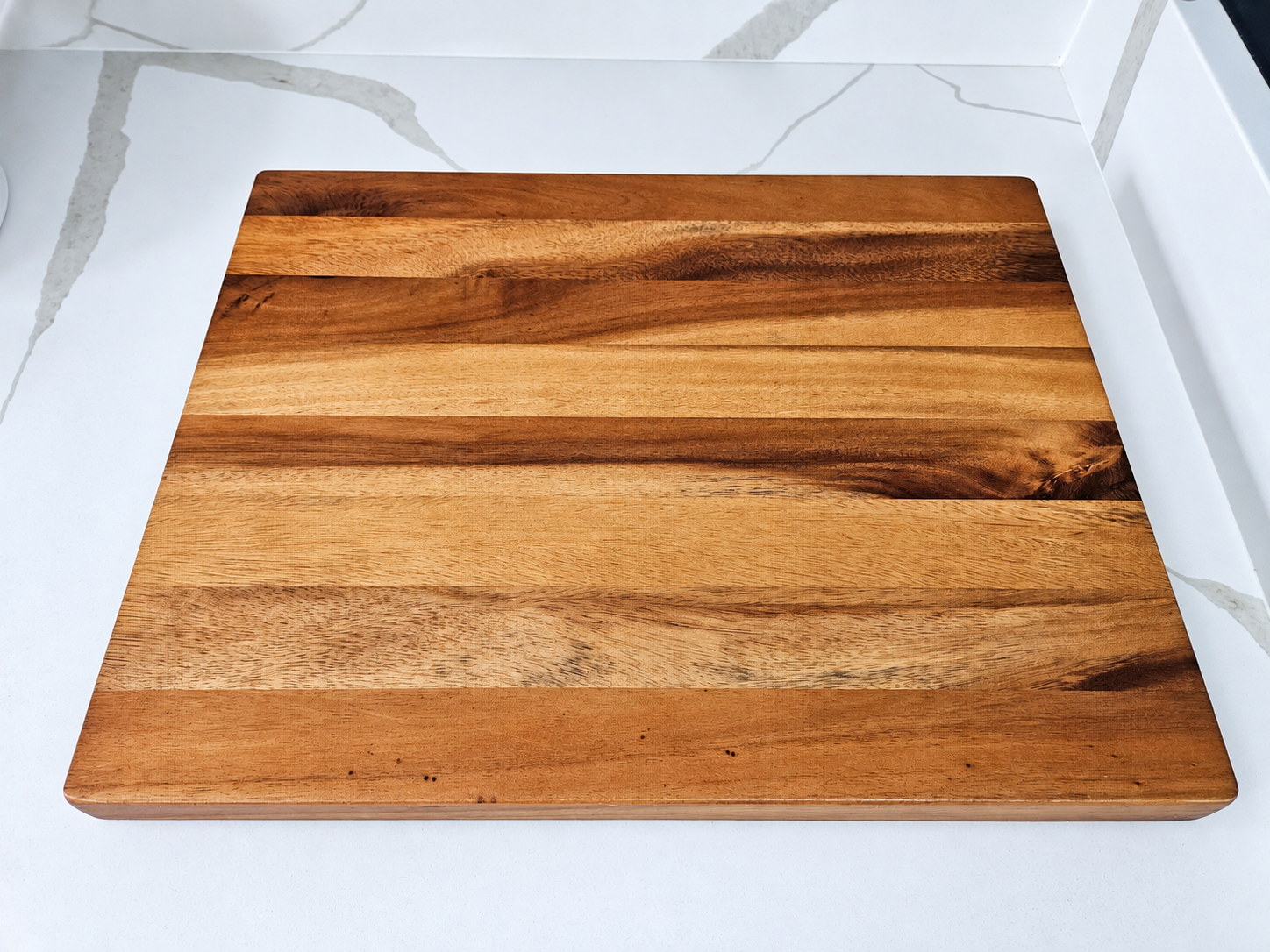
Hardwood
Quality wood gives slightly beneath the blade rather than aggressively fighting against it. That translates to a cutting surface that feels comfortable and helps protect a properly sharpened knife edge.
Good woods to look for
Hard maple
Walnut
Cherry
Teak
Acacia
For the average home cook, maple or walnut are my favorite starting points because they offer an excellent combination of durability, stability, and knife friendliness.
Pros
Excellent for knife edges
Extremely durable when properly maintained
Stable during chopping
Attractive enough to leave on the counter
Can often be sanded and refinished after years of use
Cons
Usually requires hand washing
Needs periodic conditioning with food-safe mineral oil or board cream
Can warp or crack if soaked or improperly dried
Quality boards can be expensive
Heavy butcher-block boards can be cumbersome to move
CHEF TAKE: If you spent good money on your chef's knife, don't treat the cutting board like an afterthought. Your knife and cutting board work as a system. I would rather see someone buy one excellent knife and one quality wood board than spend a fortune on knives and chop against glass.
End-Grain vs. Edge-Grain Wood: Does It Matter?
Once you start shopping for wood cutting boards, you'll probably see two terms everywhere: edge grain and end grain.
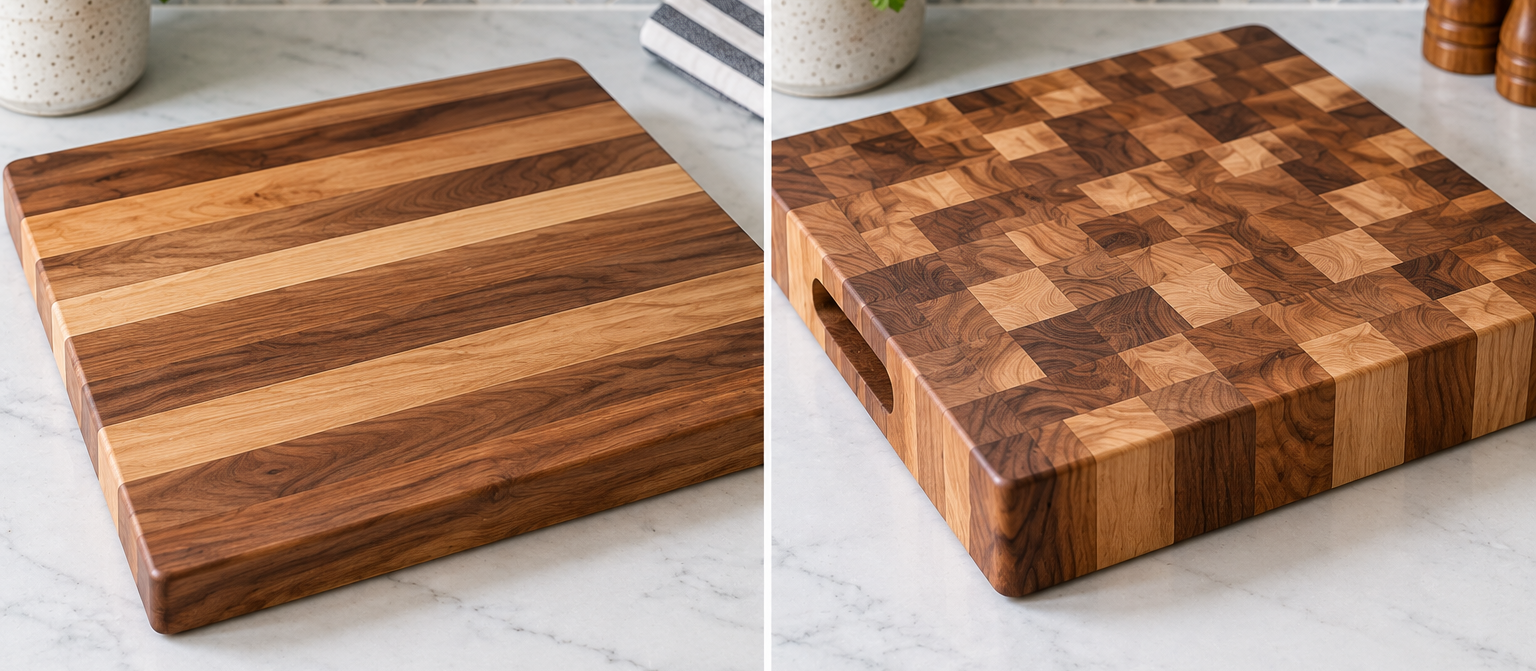
Edge-Grain vs. End-Grain Cutting Boards
Edge-Grain Cutting Boards
Edge-grain boards are made with the long edges of wood strips facing upward.
They tend to be:
More affordable
Lighter
Easier to store
Excellent for everyday home cooking
For most home cooks, a good edge-grain maple board is more than enough.
End-Grain Cutting Boards
End-grain boards expose the ends of the wood fibers.
When a knife strikes the surface, the fibers can separate slightly around the blade instead of the knife repeatedly cutting straight across them.
That makes end grain particularly appealing for anyone serious about maintaining a fine knife edge.
They're also usually:
Thicker
Heavier
More expensive
Visually striking
Which should you buy?
Most home cooks: Edge grain.
Knife enthusiasts or heavy daily cooks: End grain.
You absolutely do not need an expensive end-grain butcher block to cook well.
2. Plastic Cutting Boards: Best for Raw Meat
Plastic doesn't have the romance of a thick maple butcher block.
But it has one major advantage: Convenience.
Quality polypropylene or HDPE boards are nonporous, inexpensive, lightweight, and, depending on the manufacturer, dishwasher-safe. For example, OXO's polypropylene cutting boards are nonporous and dishwasher-safe.
That's exactly why I like having one available specifically for:
Raw chicken
Beef
Pork
Seafood
Other messy prep jobs
After prep, the board can go directly into the dishwasher rather than becoming another item that needs special treatment.
Pros
Affordable
Lightweight
Easy to sanitize
Many are dishwasher safe
Easy to dedicate one board to raw proteins
Available in multiple sizes and colors
Cons
Eventually develops knife grooves
Less attractive for serving
Usually doesn't last as long as a quality wood board
Needs replacement once excessively worn
I recommend replacing both plastic and wood boards once they become excessively worn or develop grooves that are difficult to clean.
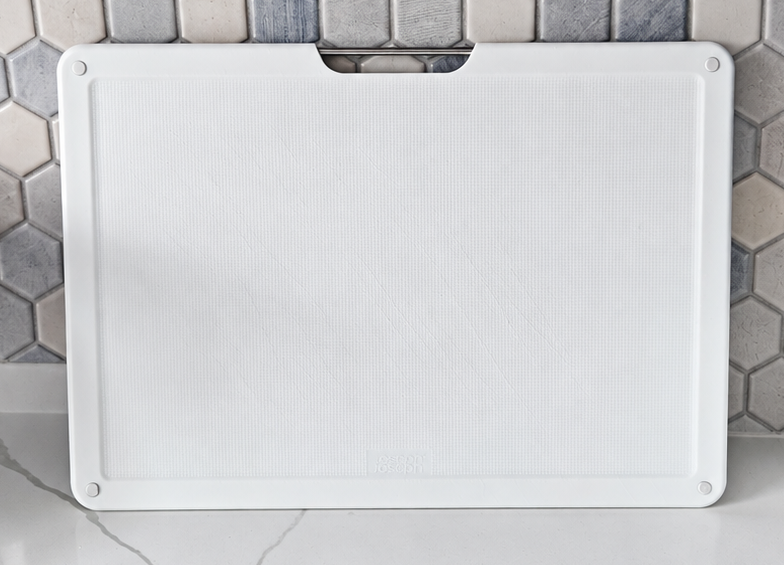
If you look really close at the photo of the white cutting board, you’ll see knife cuts and grooves. This cutting board is no longer in my rotation, but I wanted to show you what it can start to look like. I wouldn’t consider this board “excessively worn”, but it’s worn enough for my standards.
CHEF TAKE: I don't think you have to choose between Team Wood and Team Plastic. Give them different jobs. Wood handles the bulk of your chopping; plastic handles raw proteins and anything you'd rather toss straight into the dishwasher.
3. Rubber and Soft Synthetic Cutting Boards: Best for Serious Knife Owners
This is the category many home cooks don't even realize exists.
Soft synthetic and rubber-style cutting boards are common in professional and Japanese-kitchen circles because the cutting surface has some give beneath the blade.
That can make them especially attractive if you own thin, hard Japanese knives.
Hasegawa, for example, specifically designs soft-surface boards for delicate Japanese knives, and most of its full cutting boards are dishwasher-safe.
Pros
Extremely knife-friendly
Comfortable cutting feel
Often highly slip-resistant
Easier care than traditional wood, depending on model
Excellent companion for premium Japanese knives
Cons
Can be expensive
Not as decorative as wood
Some can stain
Certain rubber boards are heavy
Care instructions vary considerably by manufacturer
Best for:
Someone who owns Shun, Miyabi, Global, MAC, handmade Japanese knives, or other fine-edge cutlery and cares about preserving that edge for as long as possible.
This is more of a specialty upgrade than a necessity for most kitchens.
4. Bamboo Cutting Boards: Affordable, Attractive, but Harder
Bamboo boards are everywhere, and understandably so.
They're attractive, relatively inexpensive, and often marketed as an environmentally conscious alternative to traditional hardwood.
Bamboo also absorbs relatively little moisture and is harder and less porous than many woods.
That hardness, however, is also where I become a little less enthusiastic.
A harder cutting surface can be less forgiving on very fine knife edges than a quality maple board or soft synthetic surface.
Pros
Usually affordable
Lightweight
Attractive
Resistant to moisture
Widely available
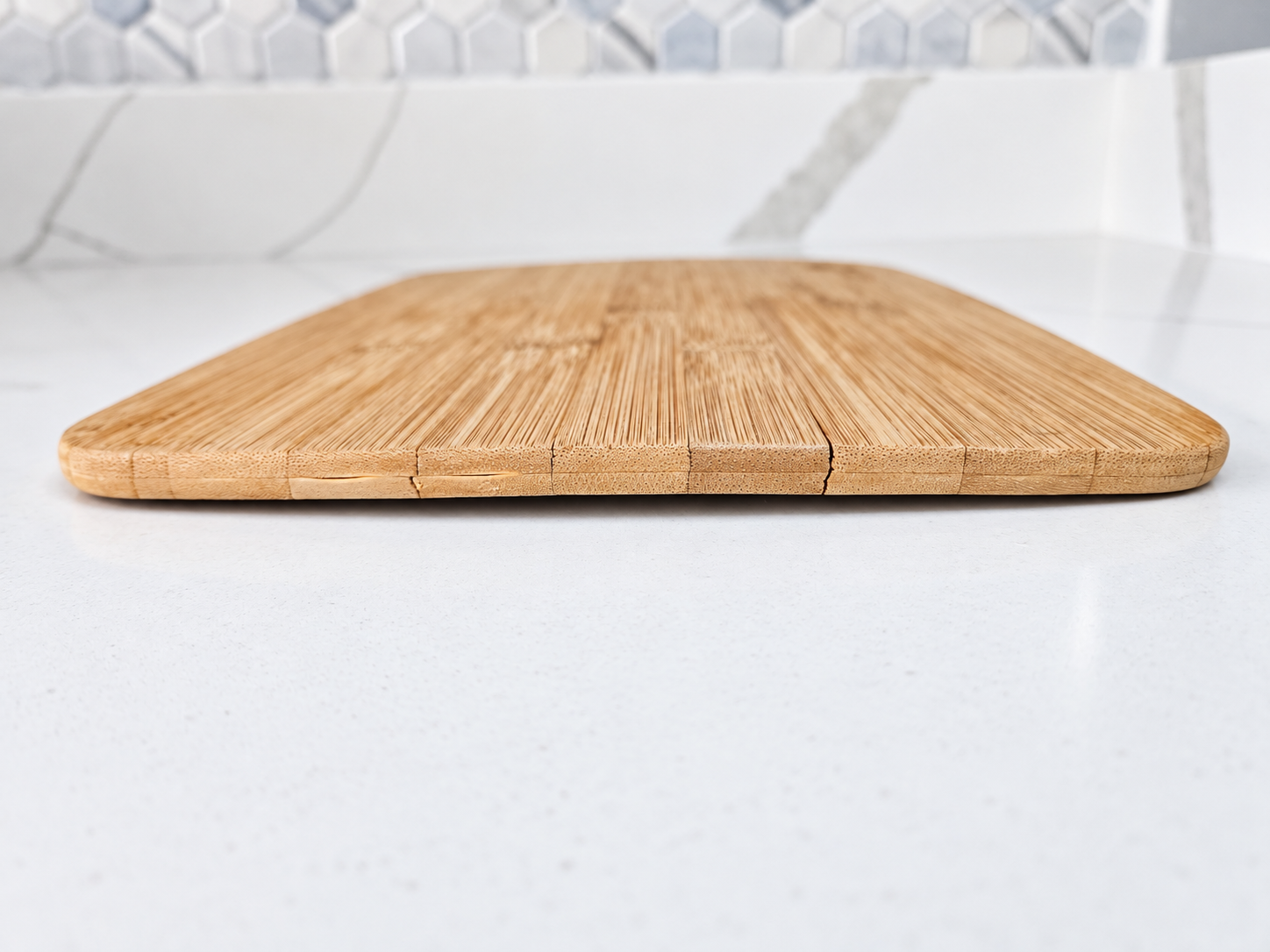
Cons
Harder surface than many traditional hardwoods
Can be tougher on knife edges
Needs hand washing
Can split or crack if neglected
Quality varies dramatically
My verdict:
Perfectly usable, but not my first choice if protecting your knives is the priority.
If the difference between a $35 bamboo board and a $100+ wood board is what gets you cooking more often, buy the bamboo board and cook.
Just take care of it.
5. Wood-Fiber Composite Cutting Boards: Best Low-Maintenance Alternative
Composite boards are an interesting middle ground.
Products such as Epicurean boards use a compressed paper/wood-fiber composite material. They're thin, lightweight, durable, and, one major advantage, many are dishwasher-safe.
Epicurean's Kitchen Series, for example, is specifically designed as a dishwasher-safe paper-composite board.
Pros
Lightweight
Thin and easy to store
Dishwasher-safe on many models
Durable
More attractive than basic plastic
Requires essentially no oiling or conditioning
Cons
Harder cutting feel than traditional wood
Not my first choice for maximum edge preservation
Can make more noise beneath a knife
Quality models may cost more than expected
Best for:
The cook who likes the idea of wood but has absolutely zero interest in oiling a cutting board.
That's a legitimate buying criterion.
6. Glass, Marble, Granite, Ceramic, Metal, and Stone: Skip Them for Chopping
Yes, they're sanitary.
Yes, they're easy to clean.
Yes, some of them look beautiful.
I still don't recommend them as cutting boards.
Glass, stone, marble, metal (don't get me started), and ceramic are extremely hard compared with the cutting edge of your knife and can accelerate dulling. These extremely hard surfaces can dull knives faster.
Use them as:
Cheese boards
Charcuterie boards
Pastry surfaces
Serving platters
Decorative countertop protectors
But don't make them your everyday chopping surface.
CHEF TAKE: Glass cutting boards are serving boards that somehow convinced people they were cutting boards. If I hear that clack-clack-clack of a chef's knife hitting glass, as my body shudders, I already know that knife is going to need some serious attention.
So, Which Cutting Board Material Is Actually Best?
Here's how I would spend my money.
Best Overall: Hardwood
Choose maple, walnut, or another quality hardwood for the board you'll use most often.
If you only want one premium board, start here.
Best for Raw Meat: Plastic
Choose a dishwasher-safe polypropylene or HDPE board and dedicate it to raw proteins.
Best for Japanese Knives: Soft Rubber/Synthetic
Worth considering if edge retention is a serious priority.
Best Low-Maintenance Option: Composite
Great for someone who wants easy cleanup without keeping another plastic board on the counter.
Best Budget Wood Alternative: Bamboo
Usable and affordable, just understand the tradeoff in surface hardness.
Material I Would Avoid: Glass, Stone, or Metal
Great serving surface… Bad cutting surface.
What Size Cutting Board Should You Buy?
Material isn't the only thing that matters.
One of the most common mistakes I see is buying a board that's simply too small.
If your chopped onion is falling over one edge while your carrot rolls off the other, your cutting surface isn't helping you.
For a primary board, I generally prefer something around 18 x 12 inches or larger, if your counter and storage space allow it.
A large board gives you room for:
Uncut ingredients
Your active cutting area
Finished ingredients
That little bit of organization makes prep noticeably easier.
For a wood board that lives permanently on the counter, something closer to 20 x 15 inches can be fantastic.
What Features Are Actually Worth Paying For?
Don't let an impressive feature list distract you from the basics.
Look for:
Adequate size
Your chef's knife should have plenty of room to work.
Stability
A board should not slide while you're cutting.
Enough thickness
Particularly with wood, a substantial board tends to feel more stable.
Reversible construction
Two usable surfaces extend versatility.
Finger grips
Very helpful on heavier boards.
Juice groove... if you actually need one
Great for carving roasts and juicy proteins. Less useful if you mostly chop vegetables.
Don't prioritize:
Fancy patterns, handles, serving compartments, engraved measurements, or decorative edges before choosing the right material and size.
Cutting Board Safety: One Board or Two?
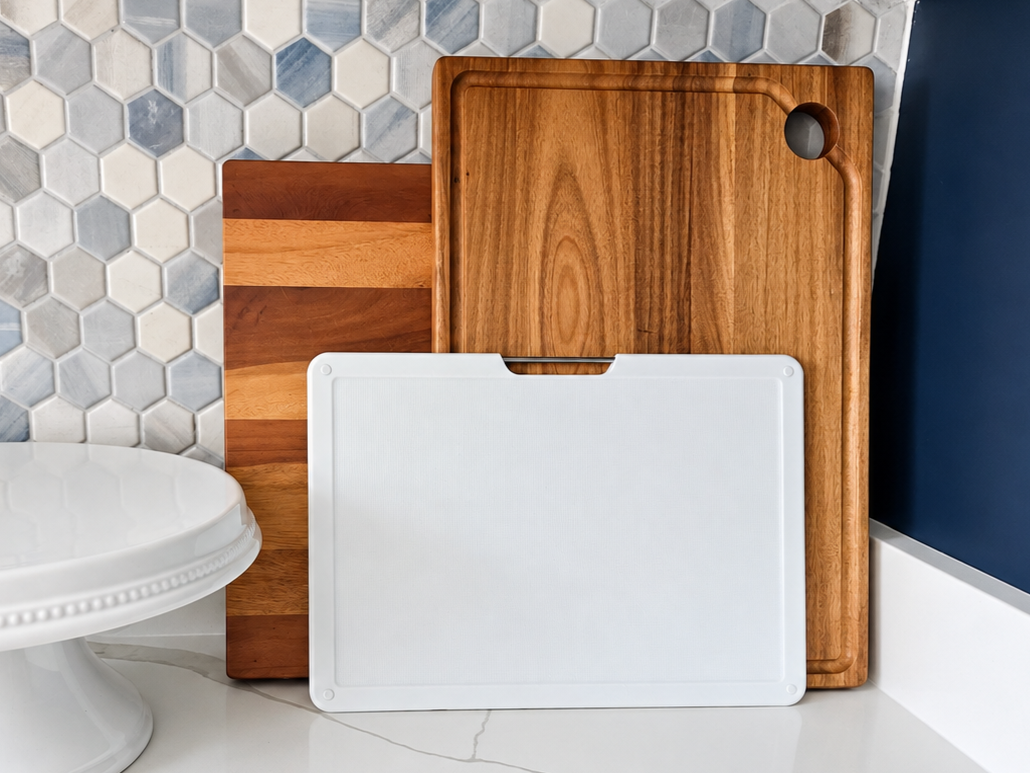
I'd vote for two.
I personally have several different cutting boards, or various materials and sizes, but who's counting?
(Not all pictured here)
Board #1: Everyday Board
Hardwood
Use it for:
Vegetables
Herbs
Bread
Cheese
Cooked foods
Most everyday prep
Board #2: Protein Board
Dishwasher-safe plastic
Use it for:
Raw chicken
Raw beef
Raw pork
Seafood
As I previously mentioned, I recommend separating cutting surfaces used for raw meat, poultry, and seafood from those used for foods such as produce and bread that may be eaten without additional cooking.
It's simple, inexpensive, and removes a lot of unnecessary food-safety gymnastics.
Cutting Board Shopping Shortlist
If you're ready to shop, these are the types of boards I'd look at first:
Best Traditional Wood Choice
John Boos Maple Edge-Grain Cutting Board
A substantial hard-maple board is exactly what I picture when I think of a classic everyday chef's prep surface.
Best for: Serious everyday cooking
Best Easy-Clean Companion
OXO Good Grips Cutting Board
Nonporous polypropylene construction and dishwasher-safe care make this the type of board I'd pair with wood for raw proteins.
Best for: Meat, poultry, seafood, quick prep
Best Low-Maintenance Alternative
Epicurean Kitchen Series
Thin, easy to store, and dishwasher-safe.
Best for: Cooks who want simplicity
Best Premium Knife-Friendly Upgrade
Hasegawa Pro-Soft
A specialized option for the knife enthusiast who really cares about maintaining delicate edges. Hasegawa describes its soft-surface boards specifically as appropriate for delicate Japanese knives.
Best for: Japanese and premium knives
Final Verdict: The Best Cutting Board Isn't Just One Board
If you're building your kitchen from scratch, don't overcomplicate this.
Start with: one large hardwood board + one dishwasher-safe plastic board.
That combination gives you a comfortable, knife-friendly everyday prep surface and an easy-to-sanitize second board for raw proteins.
If you've already invested heavily in Japanese knives, then a soft synthetic or rubber-style cutting board becomes an interesting upgrade.
Composite is excellent when convenience matters most.
Bamboo works when budget matters most.
And glass? Leave it under the cheese.
Your cutting board may not be the most exciting piece of kitchen equipment you buy, but every single knife cut you make ends there. Choose accordingly.
The 30-Second Chef Check
Before buying your next cutting board, ask yourself:
Will this surface be gentle on my knives?
Is it large enough for the way I cook?
Can I realistically maintain it?
Will it stay stable while I'm chopping?
Do I have a separate board for raw proteins?
If you've got solid answers to all five, you've probably found the right board.
Chef's shortcut: For most home kitchens, start with hardwood + dishwasher-safe plastic and stop overthinking it.
Frequently Asked Questions About Cutting Boards
-
Description text gBoth wood and plastic cutting boards can be safe when they’re properly cleaned and maintained. The bigger issue is cross-contamination.
I prefer using a hardwood board for most everyday prep and keeping a separate dishwasher-safe plastic board specifically for raw meat, poultry, and seafood. Once either type of board develops deep grooves, cracks, or damage that makes it difficult to clean thoroughly, it’s time to replace or refinish it.oes here
-
Please don't.
The combination of high heat, prolonged moisture, and harsh dishwasher detergent can cause wood cutting boards to warp, split, or crack.
Wash wooden boards by hand with hot, soapy water, rinse them, and dry them promptly. I also like to stand mine upright while drying so air can circulate around both sides.
And don't leave your beautiful wood board soaking in the sink while you finish watching your show. Your cutting board remembers.
-
There isn't one perfect schedule because it depends on how frequently you use and wash the board.
A simple rule: when the wood begins looking dry, dull, or noticeably lighter, give it some attention.
Apply a food-safe mineral oil or cutting board conditioner and allow it to absorb according to the product directions. Avoid using cooking oils such as olive or vegetable oil to condition your board. They can become rancid over time.
-
For thin, hard Japanese knife blades, I prefer a surface with a little give.
Good options include:
Quality hardwood
End-grain wood
Soft rubber or synthetic cutting boards
Specialty boards such as Hasegawa are particularly attractive for cooks who own premium Japanese knives and want to be a little more protective of those fine edges.
Glass, stone, ceramic, and metal? Still no.
-
I wouldn't call bamboo bad, but it wouldn't be my first choice if protecting a fine knife edge is your top priority.
Bamboo tends to be harder than many traditional hardwood cutting surfaces, which can make it less forgiving against your knife.
For many home cooks, a bamboo board is still a perfectly practical and affordable option. If you're investing heavily in premium knives, however, I'd lean toward maple, walnut, end grain, or a softer synthetic board instead.
-
There's no expiration date printed on the bottom. Instead, inspect the surface.
Consider replacing your board when it has:
Deep knife grooves that are difficult to clean
Cracks or splits
Warping that prevents it from sitting securely
Persistent odors or stains that won't come out
Significant deterioration
A quality hardwood board may be able to be sanded and refinished instead of replaced, which is one reason a good wood board can be such a worthwhile long-term investment.
-
Technically, you can safely use one properly cleaned cutting board for different foods.
But practically?
I still recommend two.
Keeping a dedicated dishwasher-safe board for raw meat, poultry, and seafood makes it much easier to prevent cross-contamination with vegetables, bread, fruit, and other foods that may not be cooked afterward.
It's a relatively inexpensive kitchen-safety upgrade, and one less thing to overthink while you're cooking.